How to Choose the Right Engineering Castings for Your Needs?
Choosing the right engineering castings can significantly impact production efficiency and product quality. In 2022, the global market for engineering castings was valued at approximately $116 billion, with an expected growth rate of 5.2% annually. This growth reflects the increasing demand across various industries, including automotive, aerospace, and construction. Engineering castings play a critical role in fabricating parts that need to withstand extreme conditions.
Understanding the specific requirements of your project is essential. Factors like material properties, mechanical strength, and dimensional accuracy are vital. For instance, aluminum castings are favored for their lightweight and corrosion resistance, while iron castings are appreciated for durability. However, the choice is not straightforward. Some applications demand complex geometries that may challenge standard casting techniques.
Research has shown that miscalculating the choice of engineering castings can lead to significant financial losses. Companies could face delays and increased waste. Moreover, suboptimal casting choices may cause production defects that compromise safety. Therefore, careful consideration and expert guidance are crucial in making the right decision for your project's success.
Understanding the Different Types of Engineering Castings Available
When selecting engineering castings, understanding the different types available is crucial.
Casting methods vary significantly, each with unique properties. Common types include sand castings, investment castings, and die castings.
Sand castings are versatile and cost-effective, suitable for large parts. They are made from sand molds, which allow for intricate designs.
However, surface finish might not be as refined as other methods.
Investment castings offer precise dimensions and superior surface quality.
This process uses a wax pattern covered in ceramic material. While it results in excellent details, it can be costly and time-consuming.
Die castings are known for high-volume production and uniformity.
They're ideal for smaller parts but have limitations on the size and weight of items.
While each method has its benefits, the right choice depends on your specific application and budget constraints. Reflecting on these aspects ensures a more informed decision.
Identifying Your Specific Engineering Requirements and Applications
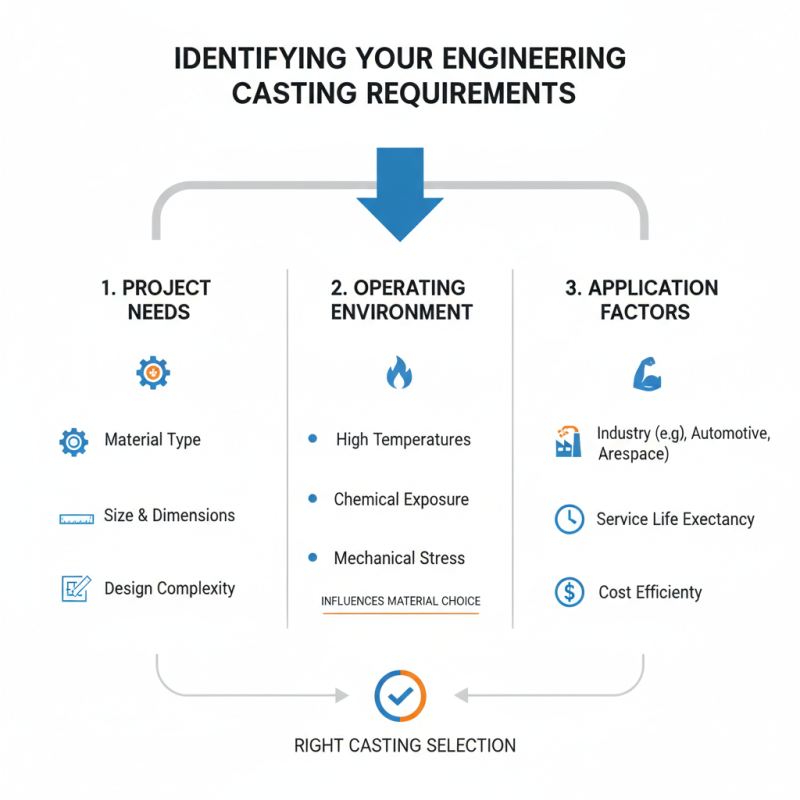
Choosing the right engineering castings requires a clear understanding of your specific needs. Different projects demand various materials, sizes, and designs. Start by identifying the environment where the casting will function. Will it be exposed to high temperatures, chemicals, or mechanical stress? Such factors significantly influence your material choice.
Next, consider the intended application of the castings. Are you manufacturing components for automotive, aerospace, or industrial machines? Each sector has unique requirements. For instance, aerospace parts may need lightweight materials with high strength, while industrial applications may prioritize durability over weight. Be aware, though, that it's easy to overlook these details in the design phase.
Lastly, consult with experts in the field to validate your choices. Their insights can help refine your selection process. It's vital to reassess your criteria regularly. Over-reliance on past experiences can lead to outdated practices. Strive for constant improvement, even in familiar tasks. This approach fosters innovation and ensures that your engineering castings are not just suitable, but optimal for your applications.
Evaluating Material Properties and Performance Criteria for Castings
Choosing the right engineering castings depends heavily on material properties. Each casting material offers unique attributes. Understanding these can narrow down options effectively. For example, aluminum castings are lightweight and resistant to corrosion. This makes them ideal for aerospace applications. However, they may not withstand high temperatures.
Consider performance criteria next. Mechanical strength plays a crucial role in load-bearing applications. Ductility and toughness also matter, especially in environments with impact forces. Evaluate how the casting will perform over time and under stress. Sometimes, a material may seem perfect but can fail in specific conditions. Testing prototypes is vital to prevent costly failures.
Quality assurance is paramount in the casting process. Look for standards and certifications that ensure reliability. Different suppliers may offer varied quality levels. A thorough evaluation can save time and resources. Balancing all these factors helps in making an informed choice. It's not just about strength; it's also about compatibility with processes and end-use.
How to Choose the Right Engineering Castings for Your Needs?
| Casting Type |
Material |
Density (g/cm³) |
Tensile Strength (MPa) |
Applications |
| Iron Casting |
Gray Iron |
7.0 |
300 |
Engine Blocks, Pipes |
| Aluminum Casting |
Aluminum Alloy |
2.7 |
250 |
Automotive Parts, Aerospace |
| Steel Casting |
Carbon Steel |
7.85 |
350 |
Heavy Machinery, Oil & Gas |
| Bronze Casting |
Bronze Alloy |
8.8 |
300 |
Marine Components, Electrical Contacts |
Analyzing Manufacturing Techniques and Their Impact on Quality
When selecting engineering castings, understanding manufacturing techniques is crucial. Different methods can yield varying levels of quality and precision. For example, sand casting is often favored for its versatility and cost-effectiveness. However, this method may not always guarantee the finest details. Precision matters, especially in applications where tolerances are tight.
Investment casting is another approach that can produce intricate designs. This technique often results in a smoother finish and higher accuracy. Yet, it comes with higher costs and longer lead times. The choice of method impacts not just quality but also the overall project timeline and budget.
It’s vital to weigh these factors based on project needs. Not every application requires the highest precision; sometimes, a robust casting with acceptable tolerances suffices. Evaluating past projects can inform current decisions. Reflecting on past challenges may reveal insights into manufacturing shortcomings. Selecting the right casting method is not always straightforward. It demands careful consideration of both the benefits and drawbacks inherent in each process.
Impact of Manufacturing Techniques on Engineering Castings Quality
Comparing Cost, Lead Time, and Availability for Optimal Selection
Choosing the right engineering castings involves careful evaluation of cost, lead time, and availability. Cost is often a primary concern. When sourcing castings, it’s essential to balance quality with budget constraints. A lower price can sometimes indicate inferior materials. Consider the total lifecycle cost, including maintenance and potential repairs.
Lead time significantly impacts project scheduling. Delays in casting availability can derail timelines. Assessing suppliers' capabilities helps manage these risks. Some manufacturers may offer faster turnaround times, but their quality should not be overlooked. Evaluate past performance and customer feedback for reliable insights.
Lastly, availability varies among suppliers. Regional differences can affect delivery times and costs. Using local suppliers might reduce lead time, yet may limit options. It's also wise to keep a buffer inventory to avoid sudden disruptions. This strategy can mitigate risks associated with unpredictable demand or supply chain issues. Making informed decisions requires acknowledging these complexities and their implications.

 +86-13516964051


 CONTACT NUMBER
 CONTACT NUMBER